
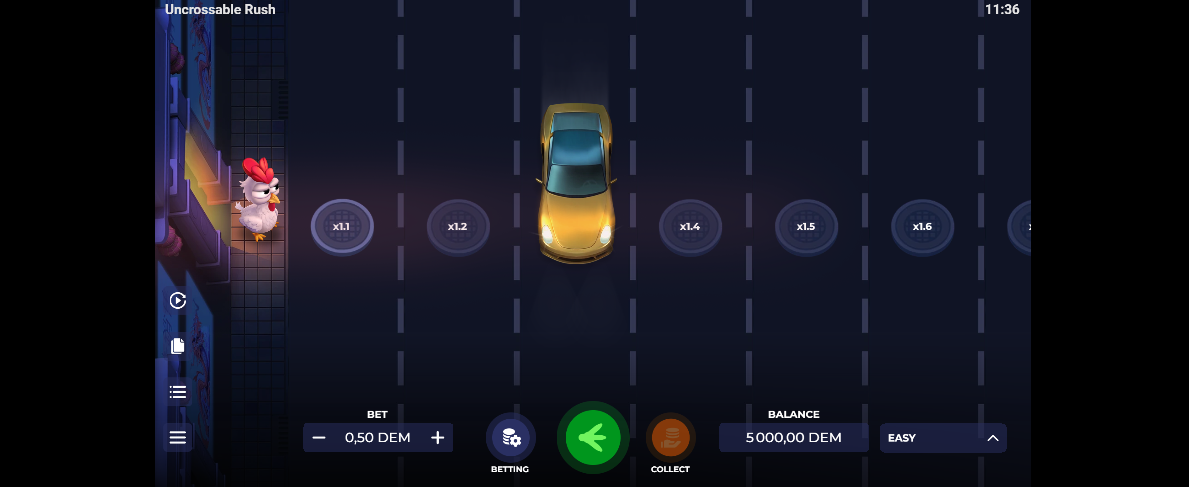
Before Eggwina sets a single foot on the asphalt in Uncrossable Rush, one decision shapes everything that follows: how busy the highway should be. That choice is made through four difficulty levels, and it fixes the speed of the traffic, the multiplier a round opens with and the size of the reward waiting on the far side.
Evoplay released the game in June 2025 as an instant title. There are no reels and no paylines to read. A round is a walk across 24 lanes, taken one lane at a time, and after every safe step the player decides between walking on and banking the multiplier reached so far.
The traffic is the risk. Every lane cleared lifts the multiplier, and every lane also brings the hit closer, because a hidden multiplier is divided into steps and any one of them can end the run. A hit costs the stake for that round, with no refund and no retry.
What follows starts with the levels, since they colour everything else: the crossing itself, the autoplay tools, the published numbers, the fairness checks and the personal limits worth setting.
Choosing a level in Uncrossable Rush
A setting has to be locked in before any round starts, and there are four of them: Easy, Medium, Hard and Hardcore. Moving up the ladder changes several things together.
- Traffic speed. Vehicles travel faster on each level above Easy, so the highway turns more hostile with every notch.
- Traffic density. Higher levels put more vehicles on the road, and the screen looks visibly more crowded.
- Starting multiplier. A harder setting opens the round on a higher multiplier, so the first lanes are worth more than on a gentler one.
- Payout potential. The reward for reaching the far side grows level by level: a full Easy crossing returns 24x the stake, a full Hardcore one 10,000x.
- Risk. Harder levels raise the danger in the same breath as the reward. One never climbs without the other.
- What stays constant. Every highway has 24 lanes, cash-out is open after any step, and being struck by a vehicle always costs the stake and closes the round.
No level is correct in absolute terms. The right one is whichever pace and risk match the budget you brought and the kind of session you have in mind.
Easy
Easy is the gentlest form the road takes. Traffic moves at its slowest, the lanes are at their emptiest, and a round opens on the lowest starting multiplier of the four.
Making it across all 24 lanes here returns 24x the stake. As an illustration, a R 10 stake carried over the full highway would pay R 240. That figure describes a complete crossing only; it says nothing about what a lane somewhere in the middle is worth.
Gentle does not mean safe. Even here, the hidden multiplier is cut into steps, and the last one may come early. A hit on the third lane costs exactly what a hit on the twenty-third costs: the entire stake.
What Easy gives is time to learn the rhythm of Uncrossable Rush. You can watch the multiplier creep up, feel what an early stop is like, and notice what happens to your nerves when you push a few lanes further. Those habits travel with you to the harder settings, so this is a good place to build them.
Medium and Hard
The two middle levels sit between the soft opening setting and the extreme one at the top. Rather than quoting full-crossing figures for them, the table describes how each behaves next to its neighbours.
| Level | What to expect |
|---|---|
| Medium | Traffic picks up noticeably over Easy, in speed and in the number of vehicles |
| Medium | Rounds open on a higher starting multiplier than Easy |
| Medium | Payout potential rises above Easy, and the danger in each lane rises with it |
| Hard | Vehicles move faster and more densely again, leaving less room for hesitation |
| Hard | The starting multiplier climbs past Medium |
| Hard | Payout potential grows further while staying below the top level |
| Both | Any hit stops play immediately, with the stake forfeited |
| Both | Collecting stays possible after each successful step |
Once Easy feels familiar, these two settings are the natural next step in Uncrossable Rush. They raise the weight of each decision without reaching the extremes of Hardcore.
The jump from one level to the next changes the feel of a session more than it seems on paper. A few demo rounds on Medium before Hard, and on Hard before anything heavier, make each shift far easier to judge.
Hardcore
Hardcore sits at the top of the ladder. Traffic is at its fastest and thickest, and rounds open on the highest starting multiplier in the game. It is the one setting where the maximum win, 10,000x the stake, is possible, and even there it requires clearing all 24 steps without a hit.
For a sense of scale, consider an illustration with a small stake: a full Hardcore crossing at R 4 would pay R 40 000. The example covers a walk that goes all the way. It is not a statement about which lane carries which multiplier.
Harder levels raise risk as much as reward, and Hardcore takes both to their limit. None of the 24 steps is guaranteed, and a hit erases the stake of that round with no second chance.
Two habits cause most of the trouble here. One is moving up to Hardcore before the lower settings feel comfortable. The other is treating every round as a hunt for the 10,000x result and refusing to collect until it shows up. In Uncrossable Rush, the top prize is a rare outcome at the end of a very long walk, not something to chase round after round.
Levels and volatility
Volatility describes how widely results swing between rounds. It is not a fixed label in this game, and several factors influence it.
- The difficulty level. Volatility adjusts with the setting chosen, so moving from Easy towards Hardcore reshapes the overall risk of a session.
- Your cash-out choices. Collecting early keeps outcomes closer together, while walking deeper into the road widens the gap between a large return and a lost stake.
- Stake size against budget. Modest stakes relative to the money set aside let a session absorb a string of hits; a large one leaves almost no margin.
- Autoplay rules. Whatever you instruct autoplay to do, win and loss actions included, affects how fast a balance can change.
- What never changes. The published RTP is 96.05%, and each step is determined at random on every level and under any settings.
Seen together, these points explain why two sessions of Uncrossable Rush on the same evening can feel nothing alike. The game is identical; the decisions around it are not.
One crossing of Uncrossable Rush
A round requires two settings: a stake and a level. The smallest stake is R 2 per round and the largest R 1 500, with the exact limits fixed by the casino, and the level is one of the four above. With both in place, Eggwina walks into the first lane.
From there, progress comes lane by lane. Each successful step raises the multiplier, and it raises the risk as well. Out of sight, a hidden multiplier has been split into steps, and nobody can tell in advance where the sequence stops. Any lane may be the final one.
After every safe step, the same question returns. Collecting closes the round and pays the stake times the value reached at that moment. Walking on puts that value back on the line in exchange for a bigger one. There is no partial option and no insurance.
If a vehicle catches Eggwina, the round is over. The stake is lost, and nothing allows you to resume from the same lane.
The presentation keeps the tension light. The highway is drawn in 3D cartoon graphics with an upbeat soundtrack underneath, and Eggwina reacts to every crossing and every hit, so each outcome reads at a glance.
One rule holds for the entire session. Every step is random, and no pattern predicts the hit. Rounds are independent of one another as well, so a run of early hits tells you nothing about the next crossing, and a streak of long ones tells you nothing either.
Autoplay settings
Autoplay runs a series of rounds based on rules you set in advance. It keeps decisions consistent and deserves the same care as manual play.
Rounds, level, stake and cash-out strategy
The first group describes the session. You select a set number of rounds, so autoplay halts by itself instead of running on. You choose the difficulty level, applied to every round in the series, along with the stake, and you define a cash-out strategy telling the game when to collect.
Fixing these values before the first round has a clear benefit: the plan is made with a cool head, away from the pull of a promising crossing. It also makes a session easy to review later, since every round followed the same instructions.
A modest round count and a stake that comfortably fits within the budget make a sound starting point. Any value can be adjusted once results on the chosen level feel familiar.
Win and loss actions
The second group determines how the stake responds to results. After a win or a loss, autoplay applies an action chosen beforehand, such as leaving the stake unchanged or altering it.
Among the available loss actions is a Martingale option, an autoplay setting that increases the stake after every losing round. Handle it with caution. Stakes rise quickly under it, a short run of hits can push them far above the starting amount, while the chances on any given lane do not change at all.
If you use these actions at all, decide on the highest stake you will accept before autoplay starts, and monitor the balance while it runs.
Auto cash-out
Auto cash-out in Uncrossable Rush works with manual play and with autoplay alike. The essentials:
- It collects for you at a point chosen before the round, so the decision does not depend on how you feel halfway through.
- It removes the urge to take one more step after the target is reached, often the very moment a round goes wrong.
- It pairs naturally with the cash-out strategy in autoplay, giving each round in a series the same exit.
- It offers no protection from an earlier hit. If Eggwina is struck before the target lane, the stake goes as usual.
- No target is safe in itself. A hit can come before any point on the road, so the choice is personal, not an advantage.
- It is worth revisiting with every change of level, since traffic pace and starting multiplier both shift.
The studio partnership
Uncrossable Rush comes from Evoplay, the studio behind it, and it holds a special place in that catalogue. Launched in June 2025, it was the first title Evoplay co-developed with SlotCatalog.
The collaboration is based on a mechanic contributed by SlotCatalog. The game operates on CrossyRun, a licensed step-crash format from SlotCatalog, which Evoplay transformed into the highway crossing, featuring four levels and a cast led by Eggwina. The core crash concept remains, with a multiplier that can stop at any moment, but it is divided into separate steps that you control individually.
Keeping the roles separate avoids confusion. Evoplay develops the game but does not manage player accounts. Real-money play is offered by licensed online casinos that feature Evoplay titles, and those operators handle registration, payments, limits and promotions.
Promotions require careful reading. Bonus terms are drafted by each operator individually. They clarify what portion of instant-game play counts towards wagering, list any excluded titles, and set a cap on the size of a single bet while a bonus is active. Checking these terms upfront can prevent surprises during withdrawal.
RTP and stake range
The published figures for Uncrossable Rush are few and straightforward, and the table compiles them.
| Figure | Detail |
|---|---|
| RTP | 96.05% |
| Volatility | Varies with the chosen level and the player's own choices |
| Lowest stake | R 2 a round, subject to the casino |
| Highest stake | R 1 500 a round, subject to the casino |
| Lanes in a crossing | 24 |
| Easy, all lanes cleared | 24x |
| Hardcore, all lanes cleared | 10,000x |
| Top win | 10,000x, available on Hardcore only, once all 24 steps are completed |
RTP is a theoretical figure calculated over a large number of rounds. It reflects the long-term mathematics of the game, not what a single session may yield. A short evening could conclude well below 96.05% in either direction, which is why it should never be considered a guarantee.
The stake range varies by operator, meaning limits at one casino might differ from another. Within the available range, choosing a stake that is small in relation to the session budget is the simplest way to stretch your funds.
Hash checks and certified randomness
Every result in Uncrossable Rush is generated by a certified RNG. That generator determines where a round concludes, and the hidden multiplier follows from it.
The game also facilitates provably fair checks. A hash generator allows round results to be verified, giving players who seek reassurance about a past round a tool for verification instead of relying on trust.
The practical implication is straightforward. With every step random and every round independent, nothing outside the game can predict where the next hit will occur. So-called predictors, bots, signal groups and paid tip services all claim to sell a pattern that does not exist. The same goes for anyone offering a modified version with better odds.
Fake websites imitating the game are an additional risk. Sticking to licensed casinos that list Evoplay titles is the safest way to access the genuine version, with its certified generator and verifiable results.
Demo and devices for Uncrossable Rush
Accessing the game requires minimal effort. It’s worth noting before your first round:
- A free demo runs without registration or any download. Use it to explore all four levels, autoplay and the automatic collection feature while no money is at stake.
- Desktop computers, tablets and mobile browsers are all compatible with the game's optimisation, so it loads directly in any browser you use.
- No app or APK is necessary. Any download claiming to be the game, or something that enhances it, should be treated with suspicion.
- A stable connection is crucial on a mobile device, as rounds progress quickly and losing signal mid-crossing can be frustrating.
- On a small screen, check the stake and level before each round, since a single mis-tap can alter a session.
- Playing for real money requires a licensed online casino offering Evoplay games, and you must be 18 or older.
- At such a casino, the usual procedure is to create an account, verify your identity, fund it, then navigate to the instant games category and select the title there.
Limits that keep the game fun
Rounds in Uncrossable Rush can be very brief. A crossing may finish on the first lane or extend over many, with a fresh round available moments later. This pace contributes significantly to the appeal, and it is why limits are more crucial here than in slower formats.
Begin with a budget set before play, an amount whose loss would not affect daily life. Add a session time and adhere to it. Many players also establish a maximum loss and a modest target for the session: when either is hit, the session concludes, regardless of what the next round might bring.
Pausing does more than it seems. A short break from the screen interrupts the momentum of rapid rounds and makes it easier to notice when play has stopped being fun.
Casinos provide tools for this. Deposit limits, time limits and self-exclusion can be set from the account, and activating them early is much simpler than trying to stop halfway through a losing streak. Increasing stakes to recover losses seldom yields positive results, as there are no guarantees of a win and each step remains random.
Anyone who feels that gambling is no longer enjoyable should reach out to a professional help organisation; seeking help early is always easier than waiting.